People searching for recession proof jobs usually want more stability, not a guarantee. No career is completely protected when employers cut costs or demand changes. Still, essential services and hard-to-delay work often hold up better during economic weakness.
| Career factor | What to look for |
|---|---|
| Essential demand | Work people or organizations cannot easily postpone |
| Stable funding | Healthcare payments, public budgets, utilities, insurance, or required business spending |
| Local or hands-on work | Tasks that are difficult to outsource |
| Licensing or specialization | Credentials that limit the available worker pool |
| Maintenance focus | Repairing and operating existing systems rather than depending only on new spending |
| Strong outlook | Healthy long-term employment demand in current U.S. projections |
Recession-resistant careers tend to protect essential services, maintain critical systems, or reduce financial and operational risk. In the U.S., healthcare, skilled trades, cybersecurity, accounting, and community services often fit that pattern. No role is immune to layoffs, so compare demand, training costs, local hiring, and funding before switching careers.
Key Takeaways
- No occupation is completely protected from an economic downturn.
- Healthcare offers several of the strongest current U.S. growth projections.
- Electricians, plumbers, and HVAC technicians provide options without four-year degrees.
- Cybersecurity combines high median pay with strong projected employment growth.
- Training cost, licensing, location, and local employers matter as much as national growth figures.
What Makes a Career More Recession-Resistant?
A stable occupation usually solves a problem that cannot disappear when household spending falls. Medical care, emergency response, power, plumbing, security, and regulatory work still need workers. That gives these fields a different demand pattern from many discretionary services.
Funding also matters because every industry depends on someone paying for the work. Government budgets, insurance payments, regulated utilities, and required business functions can provide steadier demand. Consumer luxuries and optional corporate projects can be easier to postpone.
Current U.S. projections also support healthcare’s strength as a broad employment category. The Bureau of Labor Statistics (BLS) expects about 1.9 million healthcare openings annually during 2025–2035. Those openings reflect growth and workers permanently leaving occupations.
12 U.S. Careers With Strong Stability Signals
1. Registered Nurse
Registered nurses remain central to hospitals, outpatient centers, nursing facilities, and home healthcare. Their May 2025 median wage was $97,550. BLS projects 6% employment growth from 2025 through 2035.
RNs can qualify through approved nursing programs and must obtain state licensure. Demand also benefits from an aging population and chronic health needs. The role requires significant responsibility, so training and working conditions deserve careful consideration.
2. Home Health and Personal Care Aide
Home health and personal care aides provide an accessible route into essential care work. Their May 2025 median wage was $35,800. BLS projects rapid growth of 18% through 2035.
Many positions require a high school diploma, while some require less formal education. Training rules vary by employer and care setting. The field suits workers who prioritize quicker entry over higher starting pay. You might also like Cheap Wedding Venues.
3. Medical and Health Services Manager
Healthcare organizations also need people managing staff, budgets, records, and daily operations. Medical and health services managers earned a median wage of $123,860 in May 2025. Employment is projected to grow 24% through 2035.
A bachelor’s degree is the typical entry education, and related experience is commonly expected. This path can fit experienced healthcare workers seeking administrative advancement. Growing healthcare demand creates an added need for people who can coordinate increasingly complex services.
4. Dental Hygienist
Dental hygienists perform preventive services that remain important even when families reconsider optional spending. Their May 2025 median wage was $98,100. BLS projects 8% growth from 2025 through 2035.
Programs commonly take about three years, and every state requires licensure. Part-time work is common within the occupation. This combination can appeal to workers seeking solid pay without a four-year bachelor’s program.
5. Pharmacist
Medication needs do not disappear when economic conditions weaken. Pharmacists earned a median annual wage of $140,910 in May 2025. Current BLS projections show continued employment growth during 2025–2035.
The barrier to entry is much higher than for many careers here. Pharmacists generally need a Doctor of Pharmacy degree and state licensure. Hospital and clinical settings may offer different demand patterns from traditional retail pharmacies.
6. EMT or Paramedic
Emergencies continue during expansions and recessions, which supports an ongoing need for emergency medical workers. EMT median pay was $44,470 in May 2025, while paramedic pay was $60,600. Combined employment is projected to grow 6% through 2035.
Entry normally requires a postsecondary training program and state licensure. The work can involve nights, weekends, physical strain, and stressful emergencies. Career stability should therefore be weighed alongside working conditions.
7. Information Security Analyst
Cybersecurity protects systems that businesses, healthcare providers, banks, and governments depend upon. Information security analysts earned a median wage of $129,180 in May 2025. BLS projects 21% employment growth from 2025 through 2035.
A bachelor’s degree is a common entry route, although experience and certifications can also matter. Cyber threats can create costly operational and financial risks. Organizations therefore have reasons to preserve security functions even when other technology spending receives tighter scrutiny.
8. Accountant or Auditor
Taxes, financial reporting, audits, and compliance obligations continue during weak economies. Accountants and auditors earned a median wage of $83,680 in May 2025. BLS projects 5% employment growth during 2025–2035.
A bachelor’s degree is typically required to enter the field. Professional certification can improve opportunities in certain positions. Accounting is not immune to economic pressure, but mandatory financial functions can support recurring demand.
9. Electrician
Homes, businesses, factories, and public facilities still need safe electrical systems during downturns. Electricians earned a median wage of $63,190 in May 2025. Employment is projected to grow 9% through 2035.
Most electricians learn through apprenticeships, and licensing requirements vary by state. Maintenance work can be especially useful when customers postpone replacing entire systems. This career offers a practical route that does not normally require a bachelor’s degree.
10. Plumber, Pipefitter, or Steamfitter
Broken pipes and essential water systems often cannot wait for better economic conditions. These workers earned a median wage of $63,800 in May 2025. BLS projects 7% employment growth from 2025 through 2035.
Most workers enter through apprenticeships after high school. Many jurisdictions require plumbers to obtain a license before working independently. Repair and maintenance demand can provide steadier work than projects tied entirely to new construction.
11. HVAC Technician
Heating, cooling, and refrigeration systems require repairs regardless of consumer confidence. HVAC technicians earned a median wage of $61,010 in May 2025. BLS projects 11% growth from 2025 through 2035.
Technicians often complete a postsecondary nondegree program before extensive workplace training. Licenses or certifications may apply to particular work. Repairing and replacing existing systems provides demand beyond new building construction.
12. Social Worker
Economic hardship can increase the need for health, family, school, and community support services. Social workers earned a median wage of $61,780 in May 2025. Overall employment is projected to grow 6% through 2035.
Education requirements depend on the role and can include bachelor’s or master’s degrees. Clinical social workers face additional licensing requirements. Funding can vary by employer, so local government and nonprofit budgets still deserve review.
Which Stable Careers Do Not Require a Four-Year Degree?
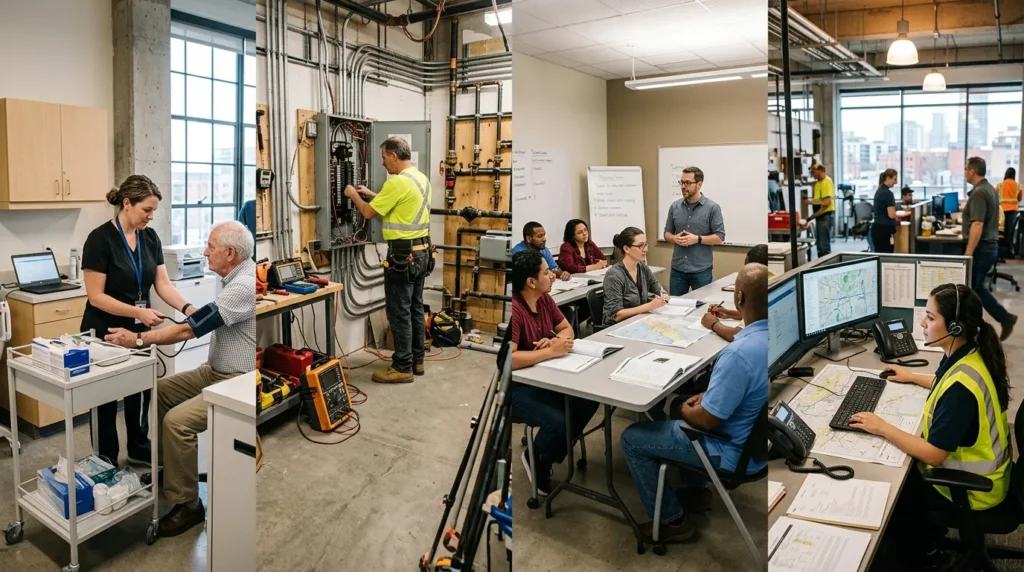
Several options above can be entered without completing a bachelor’s program. Electricians and plumbers commonly use paid apprenticeships, while HVAC technicians often complete shorter technical programs. Home care roles can have even lower formal education barriers.
Dental hygiene and emergency medical work require specialized education, but not necessarily four-year degrees. These routes still involve examinations, licenses, or state requirements. Compare tuition and expected local wages before choosing a program.
If benefits matter during a transition, Readisave’s part-time jobs with health insurance guide can help you compare alternative work arrangements. Part-time benefits can reduce pressure while you train for another field. Eligibility still depends on the employer and position.
How to Evaluate Recession Proof Jobs Before You Switch
| Question | Stronger stability signal |
|---|---|
| Can customers postpone the service? | Delaying it creates health, safety, legal, or operational problems |
| Where does the funding come from? | Public budgets, insurance, regulated services, or required business spending |
| Is the work local? | Physical presence or local licensing is necessary |
| Is the role specialized? | Credentials, licenses, or scarce skills limit substitutes |
| Is demand based on maintenance? | Existing systems require ongoing operation and repair |
A career change can be expensive, so do not compare salaries alone. Check tuition, licensing costs, unpaid training periods, commute expenses, and benefits. A lower-paying position can still improve household finances when training costs are modest.
Your local labor market also matters more than a national ranking. Search current openings within commuting distance and compare several employers. Ask whether posted roles are permanent, temporary, contract, or tied to one project.
Build Financial Resilience Alongside Career Resilience
A stable occupation cannot eliminate every layoff risk. Cash reserves can give you more time to search, retrain, or relocate after lost income. Reducing high-interest debt also lowers the amount your next paycheck must cover.
If you carry card balances, Readisave’s purchase APR guide explains how purchase interest can increase repayment costs. Workers building emergency savings can also review Readisave’s LMCU overview and savings information. Compare any financial product with your current first-party terms before deciding.
You can strengthen your current position without immediately leaving your field. Keep required certifications current, document measurable work results, and build skills used by multiple employers. Maintaining professional relationships can also shorten a future job search.
Frequently Asked Questions
What are recession-proof jobs?
They are occupations that tend to face steadier demand during economic downturns. Essential services, maintenance, healthcare, safety, compliance, and infrastructure often provide stronger signals. The term does not mean layoffs are impossible.
What careers may hold up well during a recession?
Healthcare, utilities, skilled trades, accounting, cybersecurity, emergency services, and community support often have useful structural advantages. Their services are hard to postpone or eliminate. Stability still varies by employer, location, funding source, and recession type.
What is a high-paying recession-resistant career?
Pharmacists, information security analysts, healthcare managers, registered nurses, and dental hygienists all have strong current U.S. median pay. Entry requirements differ sharply between those occupations. Compare education costs against realistic earnings in your state before committing.
Can I find stable work without a college degree?
Yes, several trades provide structured paths through apprenticeships or technical education. Electricians, plumbers, and HVAC technicians are three clear examples. Licensing and training rules still vary by state and locality.
Are technology careers safe during recessions?
Technology is too broad to treat as one category. Security work can remain valuable because cyber risk continues when budgets tighten. Product, hiring, and discretionary technology projects can face different pressures.
Choose Stability Based on the Work, Not the Label
No career deserves a permanent “safe” label because every downturn affects employers differently. Focus instead on essential demand, funding, credentials, local shortages, and the cost of entering the field. Those factors tell you more than a generic career ranking.
Start by selecting three careers that match your skills and available training time. Compare local openings, pay, benefits, education requirements, and licensing rules before applying. That process can help you pursue greater career stability without making a rushed financial decision.