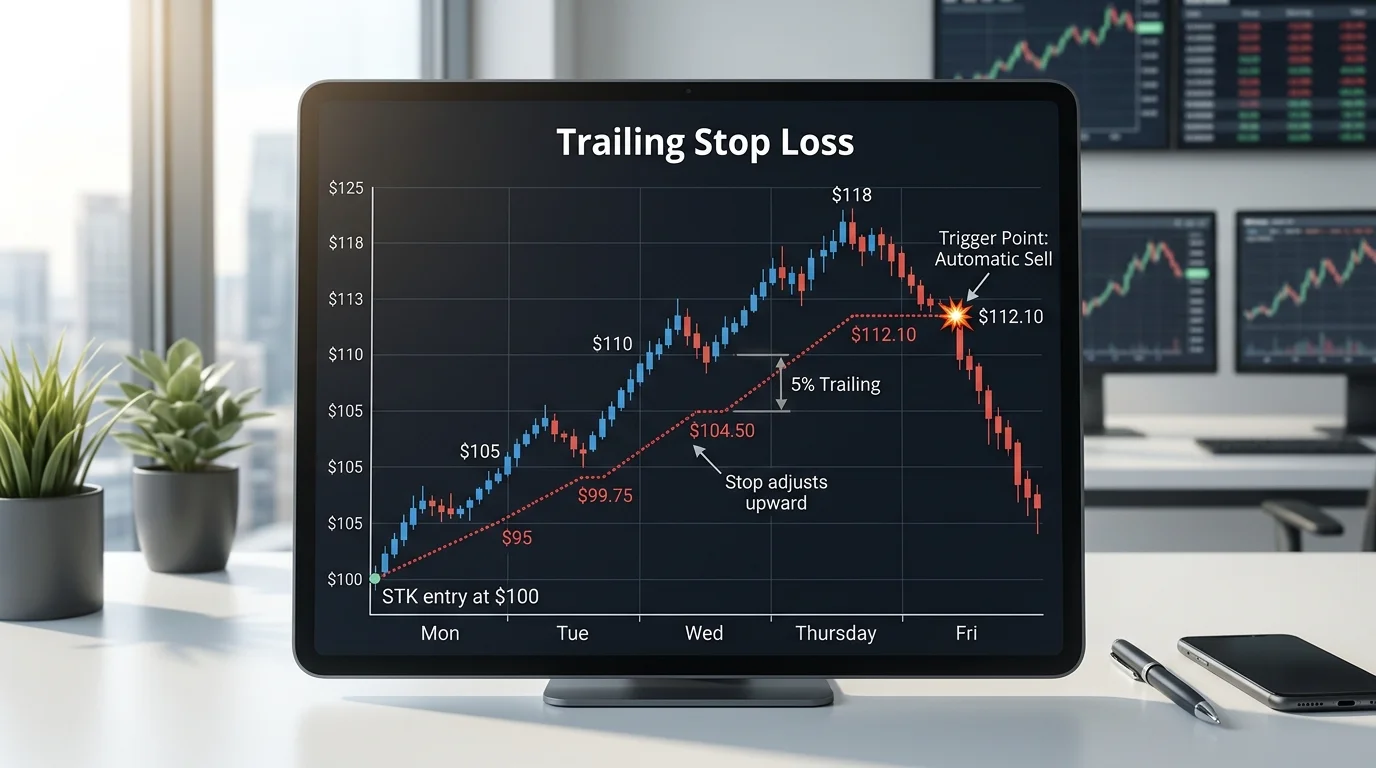
A trailing stop loss is an order that moves with a favorable price trend but stays fixed when the market reverses. For a long position, the stop rises as the asset reaches new highs. If the price falls by your chosen dollar amount or percentage, the order is triggered. It can help manage exits, but it cannot guarantee a specific execution price.
| \\*Key point\\* | \\*What it means\\* |
|---|---|
| Main purpose | Follow favorable price movements while defining an automatic exit trigger |
| Trail setting | Usually a percentage or fixed dollar amount |
| Long position | The stop can move higher but does not move lower |
| Short position | The stop can move lower as the market falls |
| Trigger result | Often becomes a market order, depending on the order type and broker |
| Main risks | Slippage, price gaps, volatility, and premature triggering |
| Availability | Features and triggering rules can differ by broker |
Direct answer: A dynamic stop follows the market by a preset distance when the price moves in your favor. It stops moving when the price reverses. If the reversal reaches the current stop level, the order is triggered. This can help protect part of an unrealized gain, but the final execution price may differ from the trigger price.
How a Trailing Stop Loss Works
The easiest way to understand this order is to think of its stop price as moving in only one favorable direction. Suppose you buy a stock at $100 and choose a 10% trail. The initial stop level is $90. If the stock climbs to $120, the moving stop rises to $108. If the stock later reaches $150, the stop rises to $135.
If the price then falls to the trigger level, the order is activated. The stop does not move downward simply because the market begins to fall. That one-way movement separates this order from a fixed stop. You can usually set the trailing amount as either a defined percentage or a dollar amount above or below the current market price.
Percentage Example
Consider this simple long-position example:
- You buy at $50.
- You choose a 10% trail.
- The first trigger level is $45.
- The price rises to $60.
- The moving stop rises to $54.
- The price later reaches $70.
- The stop advances to $63.
If the market then falls far enough to reach $63, the order is triggered. This example shows how a trailing stop loss can follow a profitable move without requiring you to reset a fixed exit price after every new high.
The calculation for a percentage trail on a long position is simple:
Current stop level = highest favorable price × (1 − trail percentage)
A 10% trail below a $70 high therefore produces a $63 stop level.
Dollar-Amount Example
You can also use a fixed dollar distance.
Imagine a stock trading at $100 with a $5 trail. The initial stop sits $5 below the relevant market price. If the stock reaches $125, the stop can advance to $120.
The dollar distance stays constant even as the asset price changes. A percentage-based distance, however, changes in dollar terms as the price rises or falls.
Broker features differ, so check how your platform defines its trigger price, eligible trading sessions, and available trailing units.
Trailing Stop vs. Fixed Stop Loss
Both orders can help automate an exit, but they respond to favorable price movements differently.
| \\*Feature\\* | \\*Fixed stop\\* | \\*Moving stop\\* |
|---|---|---|
| Initial trigger | Set at a specific price | Set by a distance or percentage |
| Moves after the price rises | No | Yes, for a long position |
| Can protect more of a rising gain | Not automatically | Potentially |
| Needs manual adjustment | Usually | Usually not |
| Can suffer slippage | Yes | Yes |
| Can trigger during short-term volatility | Yes | Yes |
A fixed stop can make sense when your exit depends on one specific price level. A moving stop is designed for situations in which you want the exit threshold to follow a favorable trend.
Neither order removes market risk.
A sell trailing-stop price generally follows the stock upward and then stops moving when the stock begins to fall. Once the trigger is reached, you may send a market order.
For more background on trading concepts, readers can browse Readisave’s Trading section. The site also covers how investors think about target returns and investment objectives.
Percentage or Dollar Trail: What Is the Difference?

Neither format is automatically better. They simply express the permitted reversal in different ways.
A dollar trail keeps the absolute gap constant. A $4 trail remains $4 away as the favorable reference price changes.
A percentage trail scales with the price. A 5% trail is $2.50 when the reference price is $50, but it becomes $5 when the reference price reaches $100.
This makes percentages easier to compare across assets with different prices. Dollar amounts can feel simpler when you already have a specific price distance in mind.
Your broker may also support other units or a separate trailing step, depending on the platform and instrument.
What Happens When the Order Is Triggered?
This is where beginners can misunderstand the protection stop orders offer.
A trigger price is not necessarily the price at which your trade will be executed. A standard stop commonly becomes a market order after the trigger condition is met. It then seeks execution at the best available market price.
Suppose your stop level is $90. Bad news arrives after the market closes, and the stock opens the next session at around $82. Your order may be activated, but you may not have an opportunity to sell near $90.
That difference is commonly called slippage.
The risk is greater during fast-moving markets, periods of low liquidity, sharp price gaps, or sudden bursts of volatility.
Readers interested in how market prices can move sharply may also find Readisave’s discussion of stock-price declines and investor sentiment useful.
Main Benefits
This type of order has several practical advantages:
- Automatic adjustment: You do not have to move a fixed stop every time the price reaches a new favorable level.
- Defined exit rule: The order creates a predetermined response to a market reversal.
- Trend participation: A position can remain open while the price continues moving favorably.
- Less manual monitoring: The trigger can update automatically, depending on the rules your broker supports.
The key benefit is automation, not certainty. The order follows predefined instructions; it doesn’t know whether a short-term decline is temporary noise or the start of a lasting reversal.
Risks and Common Mistakes
Setting the Trail Too Tight
Normal market fluctuations may be enough to trigger an exit.
A narrow trail can therefore remove you from a position even when the broader trend later resumes.
Assuming the Stop Price Guarantees the Sale Price
It does not.
Once a stop becomes a market order, execution depends on the prices available at that moment.
A sudden price gap can fill well beyond the planned trigger price.
Choosing a Percentage Without Considering Volatility
A 3% move may be unusual for one asset but completely normal for another.
The same trail distance can behave very differently across securities. This is why there is no universal “best percentage.”
Ignoring Broker Rules
Platforms can differ in their supported order types, trigger calculations, eligible market sessions, and execution methods.
Check your broker’s current documentation before placing the order.
If you are learning how orders fit into a broader trading process, Readisave’s guide to buying Bitcoin on eToro also introduces market orders, limit orders, and stop-loss settings.
When Can a Moving Stop Be Useful?
This structure may suit a position that is already moving favorably when you want an automatic exit rule if the trend reverses by a chosen distance.
It may be less suitable when normal price swings are large relative to the selected trail. It can also behave poorly during overnight gaps or periods of exceptional volatility.
Your decision should reflect your strategy, time horizon, position size, volatility assumptions, and broker rules. An order type should not replace a clear understanding of the risks associated with the underlying investment.
This article is for educational purposes only and does not constitute individualized investment advice.
Frequently Asked Questions
What Is a Trailing Stop Loss?
A trailing stop loss is a dynamic stop order whose trigger follows favorable price movement by a defined percentage or dollar amount. When the market reverses, the stop stops advancing. If the price reaches the resulting trigger level, the order is activated.
Does a Moving Stop Guarantee a Profit?
No. The position can fall immediately after the order is placed, or the execution price can differ from the trigger price. There is no guaranteed profit.
What Percentage Should I Use?
No single percentage suits every security or strategy. A narrow distance can trigger during routine volatility, while a wider distance allows a larger reversal before activation.
Does the Stop Move Backward if the Price Falls?
For a sell order on a long position, the stop generally rises as the reference price rises, then stays at its highest adjusted level when the price falls.
Is a Trailing Stop the Same as a Stop-Limit Order?
No. A standard trailing stop may trigger a market order. A stop-limit version uses a limit order after triggering, which provides more price control but creates the risk that the order won’t execute.
A Practical Next Step
Before using any automated stop, read your broker’s order documentation and identify three things: the trigger method, the order type created after activation, and the market sessions during which the broker monitors the trigger.
Then test the calculation with a hypothetical position before risking real money. A clear exit rule is useful only when you understand what the order can and cannot guarantee.